
I continually find it incredible how simple ideas can be really effective, starting out with a simple premise and really racking your brains for how many different directions you can push the basic idea. All the great musicians throughout the ages have been masters of getting every ounce of value from all the techniques they have developed.
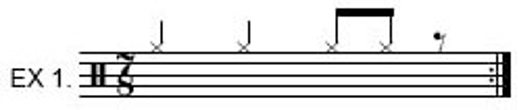
We are going to look at groups of seven and five and see how it can go in so many different directions. Let’s start by looking at the basic contours of the 7 and 5 that we will work with.
EXAMPLE 1 – Group of 7
EXAMPLE 2 – Group of 5

There are many possible groupings and arrangements of the rhythmic contours. For example the 5 grouping could be like this.
EXAMPLE 3

If we were to use this grouping juxtaposed with the 7 unit, then we get this bar of 12/8, familiar to most as the common bell pattern found in traditional afro Cuban music. Play this on the Hi Hat or ride cymbal.
EXAMPLE 4

For this article I am going to stick with the phrasing of our earlier 5 unit (Example 2) which has a slightly more Indian flavor. There is a method to this, you will see! Here are the two units together as 7 + 5 = 12. We will also add in a bass drum hit of the first note of each group of 7 and 5.

EXAMPLE 5

This will now be complimented by having a snare drum accent at the end of each unit of 7 and 5.
EXAMPLE 6

You could also play all the 'in-between' notes (Gaps) with the left hand (ghosted) on the snare if you wanted to. Next up, we will keep the kick drum as it is but place the accented snare hits earlier, before two consecutive eighth notes in each unit.
EXAMPLE 7

It is a pretty simple way to have some nice offbeat snare hits whilst the contours of the groove remains unchanged. Finally for this mini article we will have the snare hits before and after the consecutive eighth notes in each unit. Good luck and hope you get further into developing this idea on your own.
EXAMPLE 8

Copyright Pete Lockett 2020